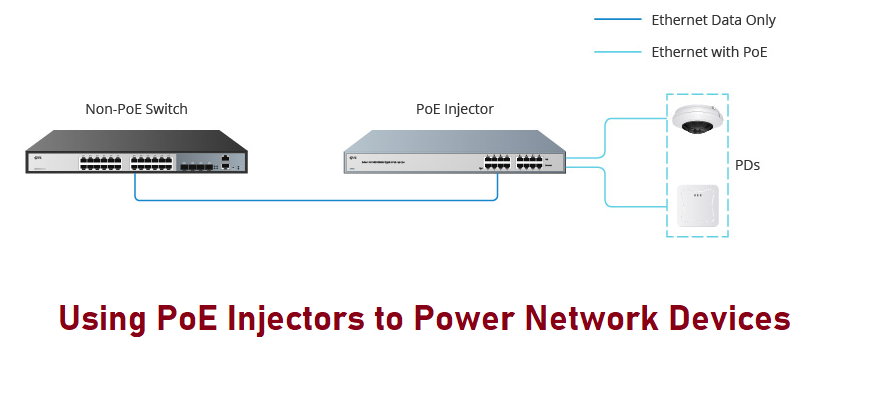
Business growth demands network upgrades, but building a new system from the ground up is not always economically feasible. Power over Ethernet (PoE) injectors bring PoE functionality to existing networks, especially those employing non-PoE switches. By providing power to devices such as wireless access points, IP cameras, and VoIP phones over existing Ethernet cables, a PoE injector eliminates the need for separate power and data cables. Installation is simplified, and clutter is reduced in remote locations or when retrofitting non-PoE networks.
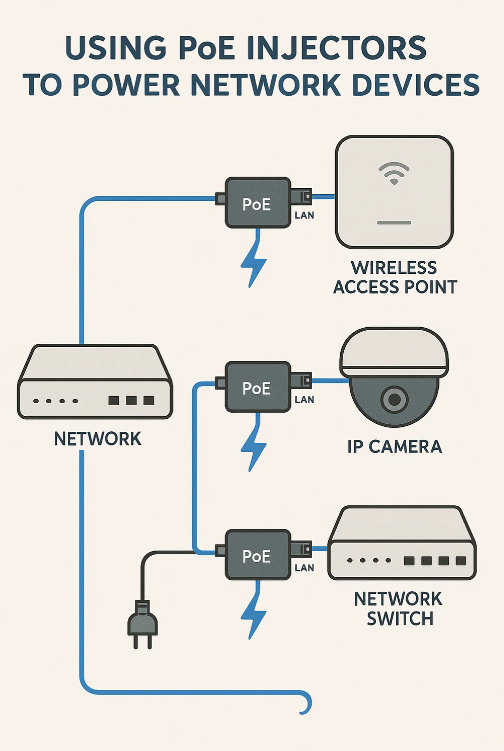
PoE injectors provide cost-effective extension/expansion solutions for growing businesses.
Retrofitting Non-PoE Networks
PoE injectors allow legacy switches to support PoE devices used in a network. This makes it easy to upgrade a system without the expense of new PoE switches. Rather than replacing the entire switch infrastructure, a PoE injector is placed between the non-PoE switch and the PoE device. The injector acts as an intermediary device that “injects” electrical power into the Ethernet cable, allowing data and power to be carried to the PoE-enabled device.
To retrofit a network:
- Using a standard Ethernet cable, an existing non-PoE network switch is connected to the “Data In” port of the PoE injector. This cable is dedicated to carrying data only.
- The PoE injector is plugged into a standard AC power outlet. This provides electrical power to a second Ethernet cable, which powers the connected PoE device.
- The second Ethernet cable is connected from the “PoE out” port of the PoE injector to the PoE-enabled device. This cable transfers both power and data without the need for a separate power adapter.
Incorporating a PoE injector into existing infrastructure extends the lifespan of non-PoE switches and helps maximize the original investment. It provides an economical solution to growing a complete PoE network over time.
Remote Device Deployment
In locations where traditional power outlets are unavailable, impractical, or costly to install, PoE injectors significantly simplify the process of delivering both power and data to devices. For example, a PoE injector can power security cameras mounted on a ceiling or installed outdoors without running separate power cables.
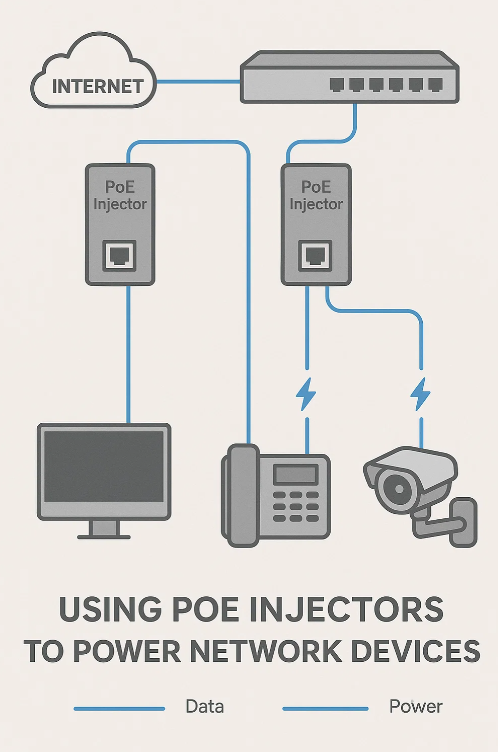
For remote device deployment, PoE injectors offer:
- Placement flexibility: Devices can be placed in optimal locations with fewer limitations on power source proximity. This is crucial for PDs like sensors, IoT devices, wireless access points (WAPs), VoIP phones, and security cameras that must be positioned in specific areas.
- Scalability: A PoE injector is the ideal solution for adding a few PoE devices to a network with minimal investment. Additional injectors can be added as needs grow.
- Cost savings: Eliminating the need for electrical wiring and associated labor costs saves money on installation. Faster deployment reduces project timelines.
- Enhanced safety: Because PoE operates at low voltage, the risk of electrical hazards is significantly lower than AC mains power.
- The ability to leverage existing Ethernet infrastructure: An existing non-PoE network can still deploy PoE devices simply by adding an injector between the non-PoE switch and the PoE device. This prevents the need for a complete network upgrade.
Once it’s powered and connected to the network via the PoE injector, a PoE-powered IP camera can be remotely configured, monitored, and even rebooted if it has that ability.
Simplified Installation and Reduced Clutter
PoE uses the wiring pairs within an Ethernet cable for transmission. By combining data and power on a single cable, PoE injectors reduce the number of cables needed for device installation. Connection is basically plug-and-play. Simplified network setup and reduced clutter make managing and maintaining the network easier. It also increases safety in industrial and commercial settings.
Extending PoE Reach
A standard PoE injector adds power to a data line for a single 100-meter segment. When combined with a PoE extender, a PoE injector becomes part of the solution to extend the reach beyond 100 meters. Acting as a repeater, a PoE extender receives the combined power and data signal. It uses a small amount of that power to regenerate and boost both signals. It then re-transmits it over another segment of Ethernet cabling.
Multiple extenders can be used to create a “daisy chain” to reach even longer distances. This is particularly useful when devices are located far from the main switch.
Are there any considerations involving the use of PoE injectors?
Most PoE injectors are single-port devices. That means one injector is needed for each PoE device needing power. High-quality Ethernet cables (Cat5e or Cat6/6A) are recommended to minimize power loss over longer distances and ensure reliable performance. It is important to ensure that the PoE injector provides enough power to support connected PoE devices.
While a PoE injector is not as comprehensive as a PoE switch, the power for connected devices can still be managed, to a degree. Some injectors even offer monitoring features.
The I69-206 Industrial Gigabit 95W POH PoE Injector
The I69-206 Industrial Gigabit 95W PoH PoE Injector from Versa Technology can power numerous PDs and transmit data over network cables remotely. With 95 watts of power output, it is ideal for devices requiring high power consumption, such as:
- PoE cameras
- PoE camera housing equipped with a blower, heater, illuminator, and wiper
- IP speed dome cameras
The injector meets the IEEE 802.3at standard for POH (Power over HDBaseT) technology, and IEEE 802.3bt standard for PoE++. It offers 12 KV PoE surge protection. With an operating temperature of -40ºC and 75ºC (-40ºF and 167ºF) and a storage temperature of -40ºC and 85ºC (-40ºF and 185ºF), it provides an easy way to deliver power and data to PoE cameras, PoE access points, and digital signage.
The I69-206 PoE Injector supports a 10/100/1000BASE-T LAN environment and automatically detects and protects non-standard Ethernet terminals. With a plug-and-play installation, it provides safe and reliable power to PoE cameras and WLAN access points.